



















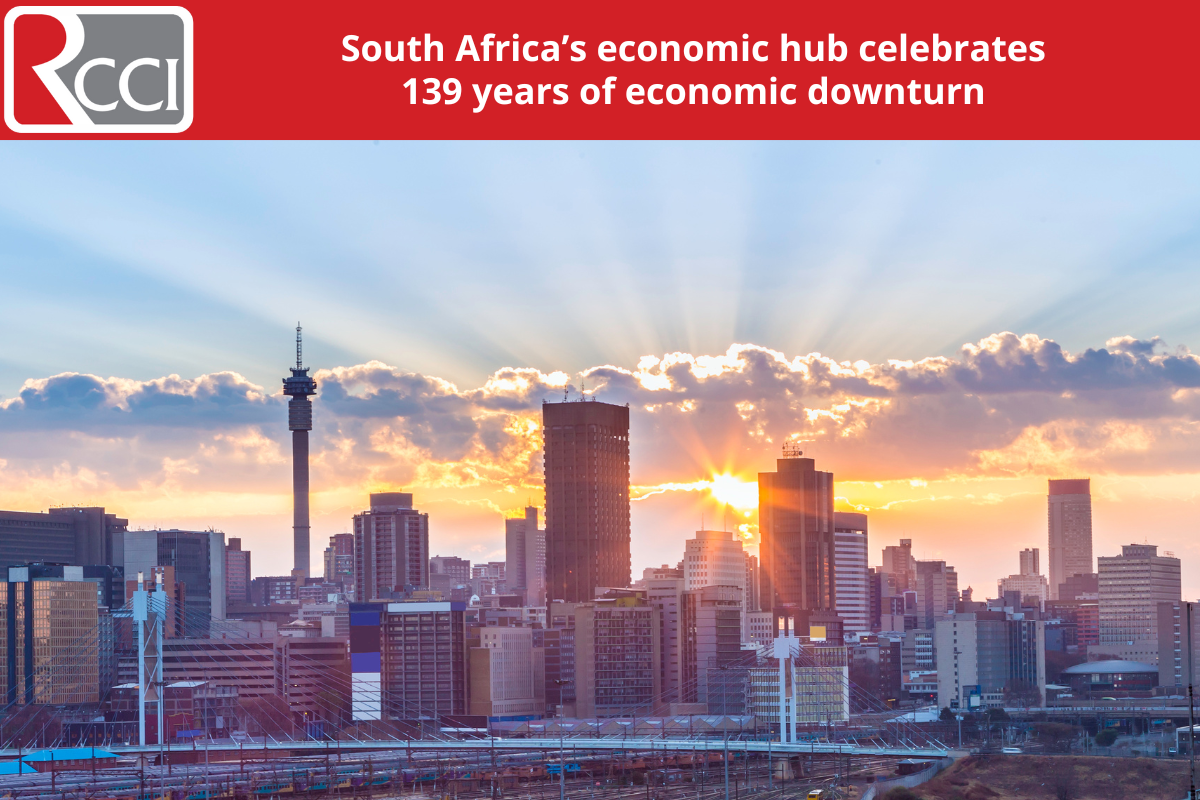
The City of Johannesburg is celebrating its 139th anniversary this October. Marking the month in 1886 when it was founded following the discovery of gold. The city, which is the economic hub of South Africa and a major financial centre in Africa, is set to host the G20 summit in November 2025 to showcase its culture and infrastructure.
The economic powerhouse of South Africa, Johannesburg generates 17 percent of the country’s gross domestic product, mostly through the manufacturing, retail and service industry sectors. Top global companies like MacDonald’s, Zurich Re, Nokia, Toyota and Coca-Cola, to name a few, have their South African head offices in the city.
Crumbling infrastructure
Crumbling infrastructure in Gauteng, particularly in Johannesburg, is driving wealthy residents to seek better living conditions elsewhere.
A draft medium-term budget released by the City of Johannesburg for the upcoming financial year indicates minimal increases in funding for three key units grappling with severe infrastructure issues.
The proposed budget for 2025/26 allocates only a 13% increase in spending for City Power and the same percentage for Johannesburg Water, while the Johannesburg Roads Agency is set to receive a mere 2% increase in its budget.
Johannesburg is seemingly battling with endless water and power outages, some of which last for days on end, while some of the multitude of potholes are large enough to write off a car.
While “infrastructure development” is among the City’s priorities, Henley & Partners’ recently released Africa Wealth Report for 2025 shows that the number of high-net-worth individuals living in the financial capital of South Africa has been decreasing.
The report found that the number of millionaires in Johannesburg had dropped 35% year-over-year, while Pretoria had seen a decline of 15%. Cape Town, however, was up 33% and the Winelands had an astonishing 42% gain.
The Garden Route was also a winner, with a 30% increase in the number of millionaires.
Gauteng Provincial Government spokesperson, Elijah Mhlanga, said the City of Johannesburg is in an undesirable position owing to factors of mismanagement.
“People often attribute Johannesburg’s decline solely to corruption and mismanagement. While these are significant factors, they are not the only problems. The city’s crisis is far bigger and more complicated; corruption is merely one symptom of a larger, failing system,” Mhlanga said.
“Firstly, the province’s economic geography is shifting. The trend of “urban sprawl,” marked by the development of new commercial nodes like the expanding Sandton, Waterfall City, Steyn City, and Lanseria, represents a fragmentation of the city rather than simple growth,” he said.
“Secondly, a continuously growing population is placing a huge strain on essential services like water, electricity, and housing. Finally, the city is hampered by a fundamentally broken municipal funding model.”
Tourism
Laura Vercueil, the Public Relations and Communications Manager for Joburg Tourism, expressed the city’s enthusiasm for the upcoming season, stating, “September is Tourism Month in South Africa, with the United Nations World Tourism Organization celebrating World Tourism Day annually on 27 September. It’s also the start of the spring season, an ideal time of year to explore and experience our beautiful country and our great city of Johannesburg.”
However, while the anticipation for a bustling tourism season is palpable, recent statistics from SA Tourism indicate the need for strategic measures to revitalize the sector. The country’s tourism industry has faced significant challenges, experiencing a 22% decrease in Q1 2023 compared to 2019 levels. Despite a 57.6% increase in tourist arrivals compared to 2022, South Africa still falls short of its targets.
Addressing infrastructure development in the city
construction has commenced on the Southern Farms Mega City Project, a landmark R27 billion ($1.5 billion) development in southern Johannesburg, following the site handover at the Bushkoppies Site Camp in May 2025, property broker Ash Müller confirmed.
The initiative responds to mounting concerns over Joburg’s deteriorating infrastructure providing 43,000 homes along with schools, clinics, libraries, sports facilities, and roads, while addressing the city’s chronic housing shortage and fostering economic opportunities for local communities.
The megacity projects come as Johannesburg faces a deepening infrastructure crisis.
Over nine months, nearly 100,000 electricity outages were reported, including more than 5,000 severe incidents affecting multiple substations. Water losses from leaks, illegal connections, and ageing infrastructure account for about 45% of supply.
Sources: Inner city gazette, IOL, Business Insider