




















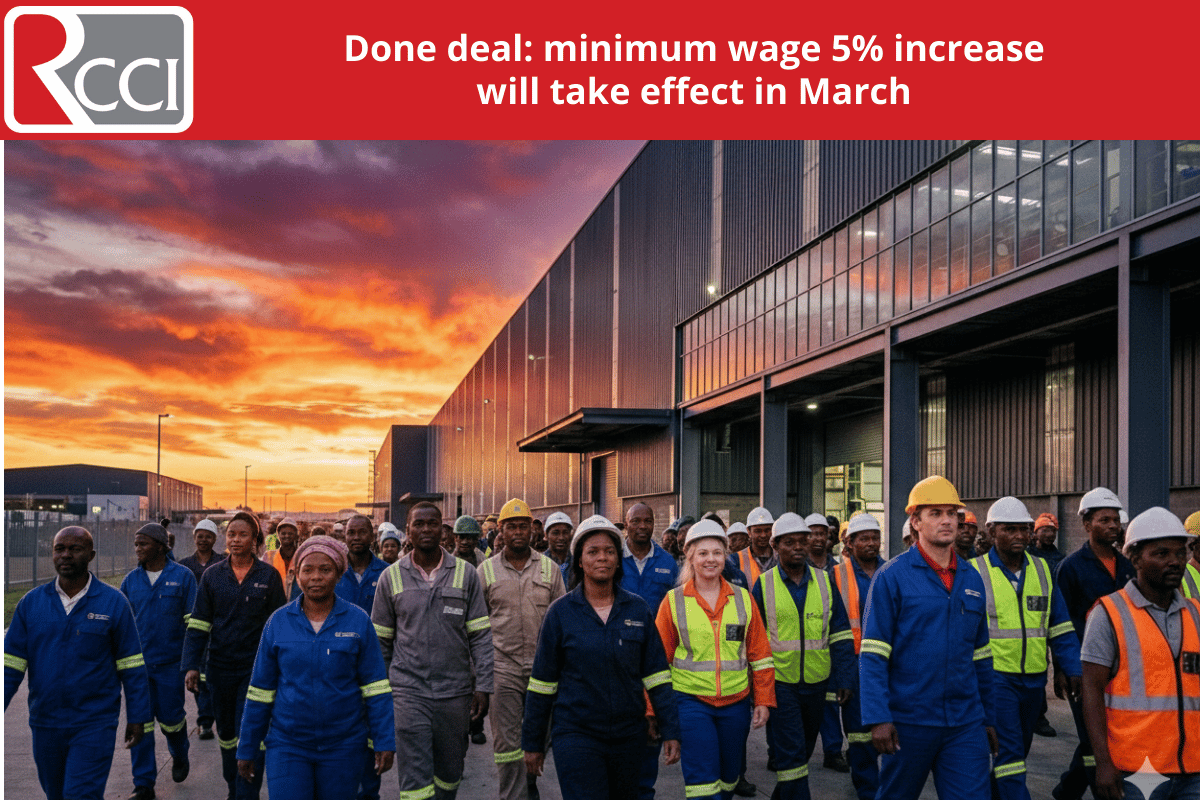
The Department of Employment and Labour has published the latest adjustments to the National Minimum Wage(NMW), increasing the bare minimum that workers, including domestic and farm workers, can be paid.
The National Minimum Wage council made recommendations in 2025 for the NMW to be increased by 5% taking the rate from R28,79 to R30,23.
The wage is for all applicable workers, including farm workers and domestic workers. However, workers employed on an expanded public works programme are entitled to a minimum wage of R16.62 per hour.
For most workers, the hourly rate translates to a weekly rate of R1,264.85 (based on a 45-hour working week) and a monthly rate of R5,894.40 (based on 4.3 weeks or 195 hours).
Allowances
Employers are reminded that the NMW excludes allowances that are paid to enable employees to work (such as transport and equipment), or payment in kind (such as board or accommodation), as well as bonuses, tips or food.
Exemption
There is provision for employers to apply for exemption. The National Minimum Wage Exemption System is accessible online at https://nmw.labour.gov.za. Alternatively, employers may approach their nearest branch of the Department of Employment and Labour.
Domestic workers have been covered by the full National Minimum Wage since 2022. However, pay data from various sources indicates that the reality on the ground has not quite matched up.
On the bottom end of the scale, Statistics SA’s data on median salaries in South Africa recorded the mid-point of domestic worker salaries at R2,350 a month, or R14.69 in a typical 160-hour work month.
Statistics SA data shows that many domestic workers earn less than half the national minimum wage.
Deputy director general at the department of employment and labour Thembinkosi Mkhaliphi, said the adjustment follows the annual review process required by law. “ The National Minimum Wage Act requires that the commission review the wage every year and makes sure it is not eroded by inflation” he said
Mkhaliphi further indicated that previous increases have not reduced employment, a research commissioned by the Department and conducted by the University of Cape Town.
Compliance remains a challenge
Despite the legal framework, enforcement remains a challenge. The department of employment and labour says compliance currently sits at about 60% meaning roughly 40% of workers are not being paid the minimum wage. The department has indicated it will convene a workshop with international experts later this month to explore ways to improve enforcement.
Source: Department of employment and labour