




















2026 promise to be a year of steady economic growth despite geopolitical tensions coupled with domestic challenges. The removal from grey listing, renewed commitment to infrastructure build, the strength to the Rand and lowering inflation are some of the positive developments the country was able to achieve in the past year.
1. Local Government Elections
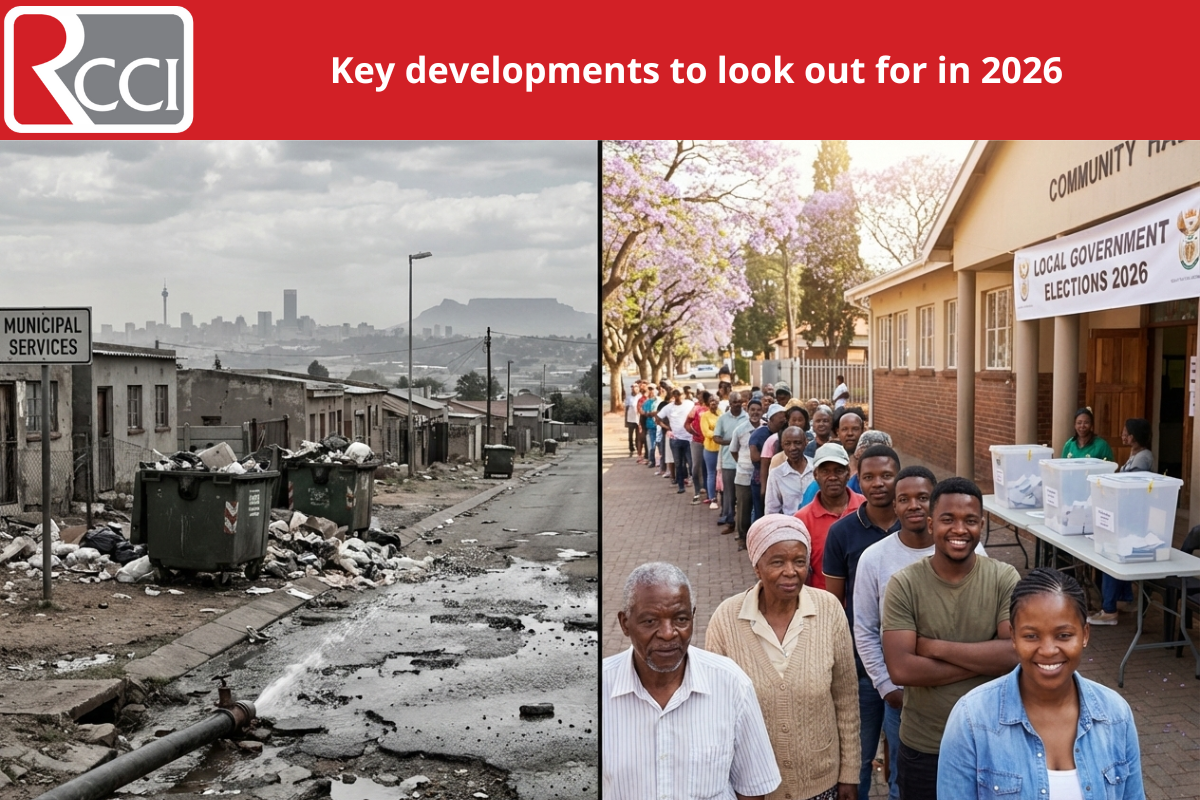
South Africa will hold local government elections between November 2026 and February 2027, which will be the first test of political sentiment after the 2024 national vote that saw the ANC lose its outright majority. These elections are widely seen as a referendum on service delivery failures especially water, electricity, waste management, and roads; and could significantly alter council control in key metros like Johannesburg, Cape Town, Pretoria and eThekwini. Political fragmentation and coalition negotiations could intensify as parties such as the DA, EFF, IFP and new groupings like Unite for Change seek leverage at the local level.
2. Economic Growth and Monetary Policy
The economy is expected to expand modestly in 2026, with GDP growth forecasts around 1.3–1.4%. Continued low inflation, anchored near the South African Reserve Bank’s new 3% target, may allow further interest rate cuts, easing financial pressure on households and businesses. However, growth remains constrained by structural issues like ‘official’ unemployment (above 30%), weak investment, and logistical bottlenecks.
3. Fiscal and Structural Reforms
Government efforts to unlock growth will continue through agendas like Phase II of Operation Vulindlela, which targets reforms in conjunction with Business 4 South Africa (B4SA) in energy, logistics, water and digital infrastructure to attract investment and improve productivity. Expanded public-private partnerships in transport, rail, and port freight systems are also expected to advance
4. Infrastructure Investment and World Bank Support
International financing will play a big role in South Africa’s infrastructure development. A $1.5 billion World Bank loan is earmarked for transport, power, water and sanitation upgrades, easing key bottlenecks that have hindered economic growth. In addition, discussions are underway for another $500 million support package to improve the national transmission grid, critical for stabilising energy supply and connecting renewable power. It is critical that inclusive public-private partnership be engaged in the spend this money.
5. Energy Market Reforms and Industry Support
To address high electricity costs and supply constraints, South Africa has eased anti-trust rules, allowing firms to collaborate on energy procurement and infrastructure projects. This aims to relieve industrial pressure and support energy-intensive sectors. Continued Eskom reforms and grid improvements will be crucial to advancing economic activity in 2026.
6. Foreign Policy and Geopolitical Balancing
South Africa’s global posture is likely to draw renewed attention in 2026. Notably, the country hosted joint naval exercises with Russia, China, and Iran (just withdrew) under the BRICS Plus framework early in the year, which has heightened tensions with the United States and sparked domestic political debate about its geopolitical orientation. Such events could influence foreign investment, diplomatic ties, and trade policy.
In conclusion, 2026 in South Africa will be shaped by pivotal elections, modest economic recovery supported by reform and investment, infrastructure upgrades, geopolitical balancing, increasing public/private ‘delivery’ partnerships and social and governance challenges. These developments together will determine whether the country can strengthen growth, stability and inclusive progress.